[Special Report Series] Assessment of North Korea's Five-Year Economic Plan
|
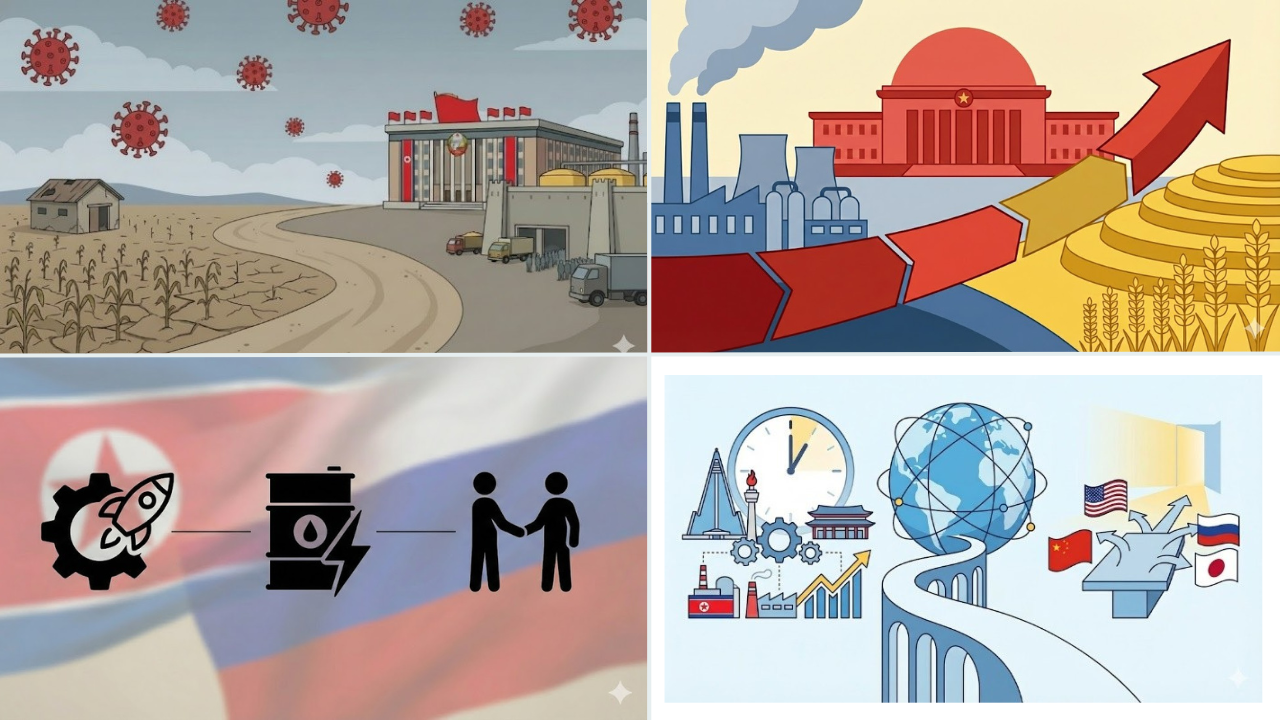
Global NK presents a special report series focused on the evaluation and future outlook of North Korea’s "Five-Year Plan for National Economic Development" (2021-2025). Each report rigorously examines North Korea's strategic responses to food and fiscal crises amidst extreme isolation—compounded by international sanctions and COVID-19 border closures. In particular, the authors provides an in-depth exploration of the limitations of the “self-reliance” line and the potential transition toward a "nuclear-based pragmatic strategy." Ultimately, this series offers critical implications for the direction of North Korea's subsequent five-year plan amid a rapidly shifting geopolitical landscape.
Assessment of North Korea's Five-Year Economic Plan
- Ji-young CHOI, ① The 2021–2025 Economic Crisis and North Korea’s Response [Read Special Report]
- Seung-ho JUNG, ② Policy Adjustment of North Korea’s 'Five-Year Plan for Economic Development': An Analysis Based on Plenary Meetings of the Worker’s Party Central Committee [Read Special Report]
- Kyoochul KIM, ③ Economic Cooperation Between North Korea and Russia Since the Russia-Ukraine War [Read Special Report]
- Jung-jin PARK, ④ Assessment of North Korea’s 5-Year Plan and the Quest for a New Diplomatic Strategy: The 9th Party Congress Outlook and the 'Gyeongju Initiative' [Read Special Report]
|
[Commentary] China’s ‘Ice Silk Road’ Strategy and Geopolitical Implications
|
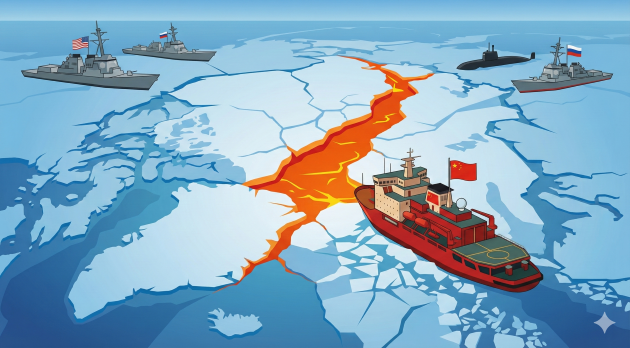
Jaewoo Jun (Reseach Fellow, KIDA) probes China's strategic intention to emerge as a "polar great power" through the construction of the "Polar Silk Road" and addresses the geopolitical shifts triggered in the Arctic region. The author diagnoses that the melting Arctic caused by climate change is shifting the center of gravity of U.S. security strategy toward homeland defense, while subtle strategic tensions are arising among North Korea, China, and Russia over access routes to the East Sea, including the Tumen River estuary. Amidst this complex security environment, Dr. Jun proposes a "preemptive stabilization strategy" and a redesign of Northern Diplomacy to help South Korea secure strategic autonomy and avoid being consumed as a frontline outpost for a specific bloc. |
|