Kim Ju Ae's Succession: Challenges to a 4th-Generation Transfer of Power
- Video Commentary
- April 16, 2026

- Won Gon PARK
- Chair, EAI Center for North Korea Studies; Professor, Ewha Womans University
Won Gon Park, Director of the EAI North Korea Research Center (Professor at Ewha Womans University), analyzes that Kim Ju Ae's succession structure is taking shape in earnest, citing the National Intelligence Service's assessment that she has been designated as heir and the emergence of honorifics reserved exclusively for the supreme leader. The author diagnoses that Kim Ju Ae's positioning at the center of state protocol and her public engagement with the people represent an intentional orchestration designed to establish her credentials as the direct-lineage heir of the Baekdu bloodline and thereby secure the political justification needed for her future formal designation. Professor Park forecasts that the age restrictions required for assuming positions within the Korean Workers' Party, the patriarchal Confucian tradition, and the absence of an independent military-achievement narrative will constitute the fundamental challenges that Kim Ju Ae must overcome to be fully established as successor.
TRANSCRIPT (Subtitles)
Hello. Today, the time has come to discuss Kim Ju Ae. This is the third time that we address her, and I feel the need to revisit the topic once more because the controversy surrounding Kim Ju Ae continues without end. Crucially, the National Intelligence Service made an announcement that Kim Ju Ae's succession structure has become more definitive, and as a result, the world's media is once again paying attention to her. Kim Ju Ae has been in the public eye for quite some time. Since her first appearance was in November 2022, it has already been four years by count. Over these four years, many things have occurred, and she has demonstrated various courses of action. However, the fact that her succession remains uncertain is one of North Korea's characteristics—the name 'Ju Ae' has still not appeared in North Korean media.
The way the name 'Kim Ju Ae' came to be known was through an interview with the British newspaper The Guardian, in which U.S. professional basketball player Dennis Rodman, who had visited North Korea in September 2013, mentioned that he had met Ri Sol Ju and held the daughter 'Ju Ae.' Because he said 'Ju Ae' in English, the precise Chinese characters or Korean spelling has not been confirmed. However, through some high-ranking North Korean defectors, the name 'Ju Ae' has become known, so I believe the name itself is correct. Nevertheless, what remains important even now is that North Korea's official media continues to use the expression 'our beloved, our esteemed offspring' rather than referring to her by name.
Current State of Heir Designation
I will summarize the National Intelligence Service's announcement. On February 12th at the National Assembly Intelligence Committee, a report was delivered stating that Kim Jong Un has been gradually revealing the succession structure toward Kim Ju Ae, and that since the end of last year, he has been highlighting her status as the second-ranked figure in protocol. To that extent, it amounted to saying that Kim Ju Ae has taken one step closer as a successor. The precise formulation was: 'It is our assessment that she has currently entered the stage of heir designation.' The National Intelligence Service cited several grounds for this, one of which is that Kim Ju Ae has built her presence at the military founding anniversary ceremony and during a visit to the Kumsusan Palace of the Sun. On January 1, 2026, the scene of the Kumsusan Palace of the Sun visit was broadcast by North Korean media, and in those photographs, Kim Ju Ae stood at the center between Kim Jong Un and Ri Sol Ju. Moreover, the overall photograph prominently featured Kim Ju Ae. Given that North Korea places great emphasis on protocol, this demonstrated that she is effectively 'the first in protocol'—the legitimate successor of the Baekdu bloodline.'
Of course, in North Korea's system, Kim Jong Un as supreme leader naturally holds first place in all protocol and is the one who should stand at the very center. However, the fact that Kim Ju Ae stood at the center on this occasion constitutes one important piece of evidence showing that she is in the stage of designation within the succession structure, as the National Intelligence Service's own phrasing suggests. In addition, the Unification Ministry official also disclosed that attention is being paid to the honorifics that have been used for Kim Ju Ae. Among these is the expression Hyangdo (向導). This is a term that appeared on March 16, 2024, meaning 'to illuminate the path forward in revolutionary struggle'—to point the direction. The reason this is significant is that the only recipients of this honorific Hyangdo are the supreme leaders of North Korea. It is an expression used exclusively for Kim Il Sung, Kim Jong Il, and Kim Jong Un. On March 16, 2024, North Korea's Rodong Sinmun published: 'The great figures of Hyangdo visited the Gangdong General Greenhouse with the Party and government and military cadres.' The fact that it is written in plural is notable. It should naturally be written in the singular to refer to Kim Jong Un alone, but the plural expression 'the great figures of Hyangdo' refers jointly to Kim Jong Un and Kim Ju Ae, who was present alongside him. In the sense that an honorific used exclusively for the supreme leader was applied, one can say Kim Ju Ae has demonstrated her status as a successor. One of the characteristics of North Korea's system is that symbolic honorifics are of great importance. Depending on which honorific is attached, one can discern whether someone has risen to the rank of supreme leader or not. Kim
North Korean Media's Continuous Glorification
Furthermore, Radio Free Asia (RFA), utilizing a source in Pyongyang in November 2023, revealed that Kim Ju Ae was referred to as 'the Morning Star Female General of Joseon'. This carries significant meaning, because Joseon refers to the entire Korean Peninsula, and being referred to as a 'star' is something that has been applied only to Kim Il Sung, Kim Jong Il, and Kim Jong Un. Kim Il Sung bears the honorific of 'the Sun', Kim Jong Il bears the honorific of 'the Bright Star', and the fact that Kim Ju Ae has been given the expression 'Morning Star' can be seen as her having taken one step further toward the succession structure. According to RFA's reporting, the Party's Organization and Guidance Department gathered officials from the Party, State Security Ministry, and Social Safety Ministry in Pyongyang and held a lecture to commemorate the satellite's success, and the expression reportedly emerged at this occasion. The precise formulation was: 'In the era of a space power, the future shall shine even more brightly under the Morning Star Female General of Joseon.' This can be considered a clear reference to Kim Ju Ae. Of course, this was not an expression that appeared officially in North Korean media, but the very fact that such an expression was used suggests that Kim Ju Ae has drawn considerably close to the honorifics befitting a successor.
Kim Ju Ae's recent conduct also shows a pattern drawing closer to the succession structure. On February 17th, as also reported by North Korea's Korean Central News Agency and Rodong Sinmun, Kim Ju Ae appeared at the completion ceremony for the construction of 50,000 housing units in Pyongyang, and her interaction with residents was exceptionally highlighted. Interaction with North Korean residents is something that has been done exclusively by the supreme leader. It is something only Kim Il Sung, Kim Jong Il, and Kim Jong Un did. This particular event was itself quite significant, as North Korea had announced at the 8th Party Congress in 2021 one of its paramount tasks: to construct 10,000 housing units per year for five years, totaling 50,000 units. Accordingly, the event held on the 17th was the completion ceremony for the Phase 4 Hwasong District project, which fulfilled the final 10,000 units—the 50,000th. At that venue, Kim Ju Ae appeared and was shown embracing North Korean residents. The very fact that Kim Ju Ae appeared at the most important project and demonstrated a posture of embracing North Korean residents underscores her emerging role in the succession structure. Clear likelihood of succession gradually increasing.
Possibility of Conflict with Kim Yo Jong
In particular, as I just mentioned, instilling the impression that Kim Ju Ae is loved by the people can be seen as work to build the justification for elevating her. Additionally, the British daily The Telegraph once reported that if Kim Ju Ae were to emerge as supreme leader, there would be a conflict with Kim Jong Un's sister Kim Yo Jong. According to this report, if a sudden contingency involving Kim Jong Un were to occur and Kim Ju Ae were designated as successor, Kim Yo Jong could engage in a power struggle with Kim Ju Ae. The report emphasized that Kim Yo Jong already has a solid foundation within the Party and the military. Therefore, if an opportunity to seize power arose, she would have sufficient prospects of victory in a power struggle against a younger niece. However, I hold a different view on this.
Because the North Korean system itself makes it difficult for Kim Yo Jong to have a solid foundation. All foundations are controlled by the supreme leader, and if Kim Yo Jong were to have her own independent foundation, it would constitute the so-called factionalism that North Korea considers most sensitive, and is therefore thoroughly prevented. Even thinking about it rationally, in a one-person authoritarian system like North Korea's, a second-in-command cannot be tolerated. For the system to become one of two commanding figures, a foundation supporting the second-in-command would have to emerge, and therefore even one's own younger sister would be thoroughly blocked. Therefore, even if a contingency involving Kim Jong Un were to occur and Kim Yo Jong were to be elevated, my basic view is that Kim Yo Jong would be unlikely to possess a power base. For this reason, conflict between Kim Yo Jong and Kim Ju Ae would be extremely difficult. Viewed from another angle, there is the matter of the so-called direct bloodline of the Baekdu bloodline. Of course, Kim Jong Un is not Kim Jong Il's eldest son. He is a direct heir, but there is a complicated family background of different mothers, is there not? In that respect it is complicated, but what is important is that Kim Jong Un's child shall take power, not his sister Kim Yo Jong—it would be extremely difficult for her to do so. She is, in a sense, a collateral branch (傍系). I consider this to be one of the characteristics of the North Korean Baekdu bloodline.
The Limitation of Age
So far, I have spoken of the likelihood of Kim Ju Ae becoming the successor of the fourth-generation hereditary succession; I will now speak of the limitations. Assuming at present that the likelihood of Kim Ju Ae becoming the successor is considerably high, if such a situation were to arise, what limitations might exist? 'There will inevitably be great limitations.' In a sense, one could view these as limitations that Kim Jong Un must overcome. First, the greatest obstacle to Kim Ju Ae emerging as successor is that North Korea operates under a party-centered system. To receive a position within the party, one must be 18 years of age or older. However, Kim Ju Ae is estimated to have been born in 2013. There are still about five more years before she turns 18, and she must become a Korean Workers' Party member at 18 before she can receive a position in the party. For reference, in the case of Kim Jong Il, his position was conferred at the 6th Party Congress in 1980, and in the case of Kim Jong Un, at the 3rd Party Representatives' Conference in 2010, where official positions within the party were conferred on each of them. Through this, the status of successor was institutionally formalized. For Kim Ju Ae to achieve this formal designation as successor, it appears she still faces the limitation that she must be older.
The Limitation of Women's Status
The limitation of being a woman also remains visible. Because North Korea's system has recently placed high-ranking officials such as Kim Yo Jong, Deputy Director of the Korean Workers' Party, along with Choe Son Hui, Hyon Song Wol, and Kim Jong Sun into senior positions, there have been claims that North Korea can also have a woman as leader. Those claims are correct. Senior positions have increased. However, viewed overall, in the Central Committee of the Party and the Politburo Standing Committee, there are still no women. Overall, the number of women in senior positions is very limited, and in particular, these women still perform functional or supporting roles rather than central roles—these are entirely different matters. Furthermore, the more Kim Ju Ae continues to be highlighted, the more speculation about Kim Jong Un's health problems inevitably surfaces simultaneously. Because Kim Jong Un is known to have been born in 1984, which means he is still young. Yet the continuing emergence of talks of a second-in-command gives rise to the reasonable inference that something is wrong with Kim Jong Un's health. Among North Korea researchers, there is a saying: 'It would be strange if Kim Jong Un's health were not strange.' He is clearly overweight and has a family medical history, and in this situation the talk of a successor—moreover, of making his own young daughter the successor—means that whenever Kim Jong Un does not appear in the media, speculation about health problems could easily flare up. Another point is that even if a daughter were officially designated as successor, she would become the second-in-command. For a second-in-command to exist means people inevitably begin to gather around, and this holds the sufficient possibility of emerging as a single faction. If such a faction emerges, the likelihood of challenging Kim Jong Un increases, and given the nature of North Korea's system, this cannot be tolerated. In the end, the core lies in persuasion within North Korea. North Korea's system itself remains extremely patriarchal. Because it is a society where Confucian tradition remains very powerfully present, there is the fundamental question of whether a female leader can be accepted.
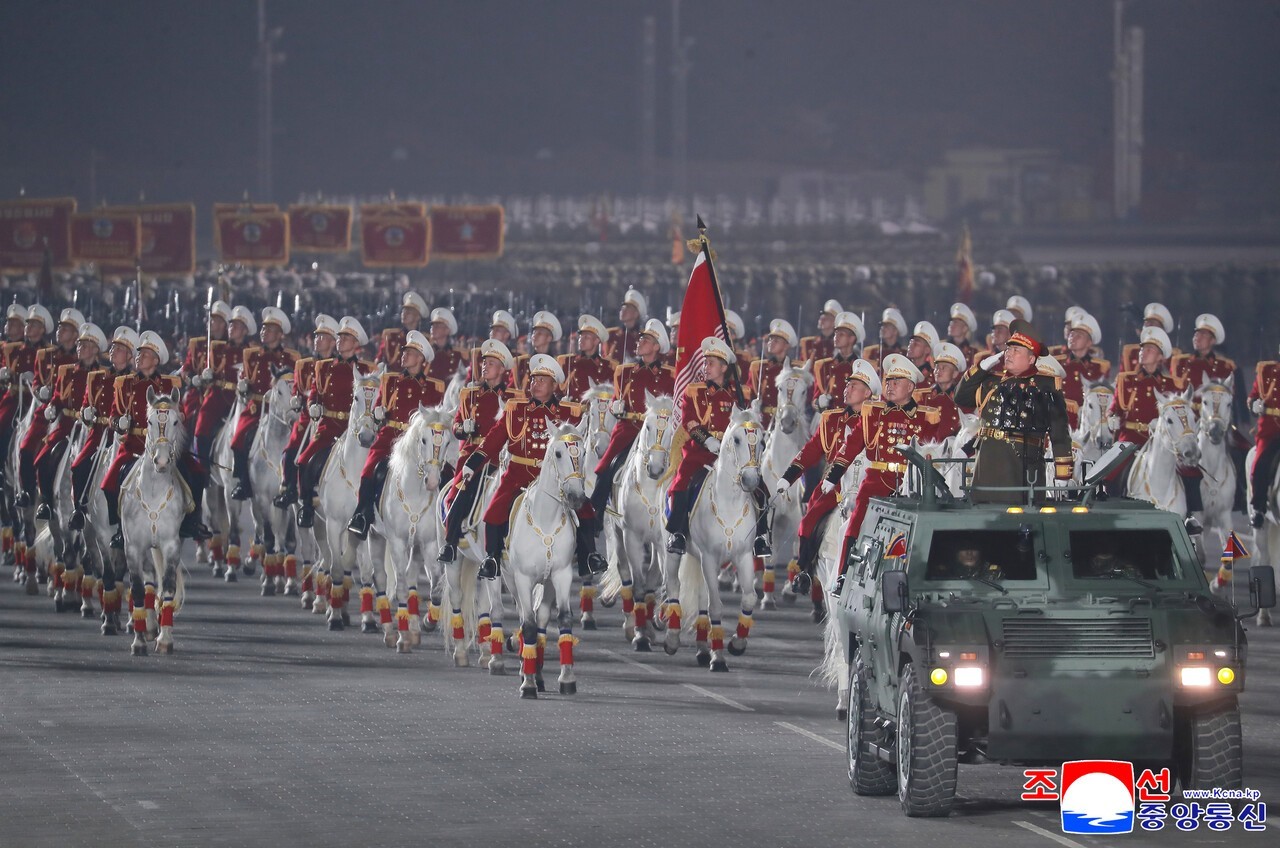
North Korea is characterized in various ways. One of these is that it is a Guerrilla State. This is a term used by Professor Wada Haruki, currently an emeritus professor at the University of Tokyo. He argues that North Korea continues to this day to utilize the narrative of Kim Il Sung's partisan struggle in the 1930s. Looking at North Korea's military parades held in recent times, the first unit to appear is the 7th Regiment, which conducted the partisan struggle. It is made into a symbolic column that appears in the vanguard on horseback.
The resistance against Japanese imperialism of the 1930s has now been transformed into a response to U.S. imperialism, and the narrative has been linked to the legitimacy of the Baekdu bloodline down to the present day. The characteristic of this narrative is that, being a guerrilla force in the literal sense, it carries a military significance. Partisan struggle means that men engage in military activity to thereby be granted legitimacy. Yet Kim Ju Ae is not a man, has no experience in military activity, and there inevitably arises the fitting question of how this narrative can continue to be embraced. Furthermore, another point is that North Korea constitutes a great family. At its apex stands the fatherly supreme leader. The expression 'fatherly' is value-neutral in conventional usage, yet it conventionally symbolizes a male. In North Korea, Kim Il Sung is continuously called 'fatherly.' In that case, the question inevitably arises as to whether Kim Ju Ae can rise to the position of the fatherly figure within a North Korean system that constitutes a great family with the fatherly supreme leader at its apex. Finally, there is the Confucian state, which is a society that places great emphasis on ideas, dislikes change, and makes use of tradition. Another of its characteristics is that it is an extremely male-centered society, and there is the question of whether Kim Ju Ae, as a woman, can exercise control over a North Korean society in which strong Confucian traditions persist.
The Absence of a Track Record
To put it more directly, even if Kim Jong Il and Kim Jong Un derived legitimacy from the Baekdu bloodline tracing back to Kim Il Sung, it is imperative that they had achievements of their own. In the case of Kim Jong Il, even amid the turmoil of the end of the Cold War, he is said to have 'achieved a breakthrough through military-first politics (Songun), by which the military is placed at the forefront—our-style socialist military-first politics.' This continues to be cited as an achievement. In the case of Kim Jong Un, as we have observed over the nearly 14 years, according to their own accounts, he created the history of placing nuclear power at the forefront by completing nuclear military power. Indeed, in the scenes where he appears with Kim Ju Ae, he appeared at the test-launch site of the Hwasong-17 intercontinental ballistic missile. Taking all of this into consideration, one is compelled to assess that there will inevitably be significant limitations as to whether Kim Ju Ae will be able to construct a narrative capable of demonstrating her own achievements—particularly a narrative that can demonstrate military achievements. Taken comprehensively, I believe it is correct that Kim Ju Ae has indeed taken one step closer within the succession structure, but it is uncertain whether Kim Ju Ae will truly be designated as successor at an early stage—or if a woman will be designated as successor.
As I speak in this manner, my own heart sinks as well. What I am speaking of is a very pre-modern matter, is it not? The formation of nation-states has seen no such precedent as three-generation hereditary succession, and yet here we are speaking of a fourth-generation succession—I cannot say I feel good about this state of affairs. Nevertheless, from the standpoint of having to observe North Korea and to sensitively track and analyze changes in North Korea's system, I have spoken regarding Kim Ju Ae's succession. I thank all of you who have watched. ■
■ Won Gon Park is the Chair of EAI Center for North Korea Studies and a Professor of North Korean Studies at Ewha Womans University.
■ Translated and edited by Sangjun LEE, EAI Research Associate; Inhwan OH, EAI Senior Research Fellow; Sowon KIM, EAI Intern.
For inquiries: 02 2277 1683 (ext. 211) | leesj@eai.or.kr