The Strategic Implications of the U.S.-Iran War and the Limits of U.S.-North Korea Negotiations
- Video Commentary
- April 02, 2026

- Won Gon PARK
- Chair, EAI Center for North Korea Studies; Professor, Ewha Womans University
Won Gon Park, Chair of the EAI Center for North Korea Studies (Professor at Ewha Womans University), analyzes the strategic implications the recent U.S.-Iran War poses for the Kim Jong Un regime. He characterizes the war as a "preventive war" executed before Iran could complete its nuclear arsenal, arguing that President Trump's unpredictability serves as practical pressure on North Korea's strategy. Professor Park identifies North Korea's nuclear obsession, shifting thresholds for U.S. negotiations, and the recalibration of South Korea-China relations amid integrated air and missile defense proliferation as key challenges for resolving the North Korean nuclear issue.
TRANSCRIPT (Subtitles)
Hello. Today, we will discuss how the currently unfolding war in Iran can be applied to North Korea and what implications it carries. Iran and North Korea are frequently compared. From the American perspective, both share the commonality of being nations that harbor animosity toward the U.S.. Iran is one of the nations that has held the banner of anti-Americanism since the Islamic Revolution in 1979, and I consider North Korea to be the oldest existing anti-American nation since the Korean War. Although Cuba also has a long history of Anti-American hostility, but North Korea’s anti-Americanism predates it. I will explain why the U.S. attacked Iran and initiated a war at this juncture from the U.S. perspective, and how this connects to North Korea.
Iran's Anti-American Stance and U.S. Policy toward the Middle East
First, I will attempt to explain why the U.S. attacked Iran. After Trump successfully removed Khamenei from power, he said it was to permanently block Iran's possession of nuclear weapons and to address an imminent threat toward the American people and its allies.
Iran's Nuclear 'Imminent Threat'... The U.S. exercises military force to prevent it. In doing so, Trump outlined about four objectives, the first of which was the destruction of Iran's ballistic missile and naval capabilities.
Second, he emphasized permanently preventing the acquisition of nuclear weapons. Third, he stated the operation was carried out to dismantle the funding, command, and foundation of pro-Iranian factions, such as Hezbollah, Hamas, and the Houthis, also known as the Terror Network Proxy. Fourth, he stated it was to urge the Iranian people towards a regime change.
These are the details announced by President Trump himself. I will now explain why the relationship between Iran and the U.S. has deteriorated to the point of waging war, and why the U.S. initiated this currently ongoing war from its perspective.
The first is that the relationship between the U.S. and Iran is exceptionally poor. The U.S. harbors a strong dislike for Iran. In 1979, Khomeini led the so-called Iranian Revolution, which resulted in the Pahlavi Dynasty's collapse. Furthermore, during the Khomeini revolution, the U.S. Embassy hostage crisis occurred also known as the Tehran hostage crisis.
At that time, there was an incident where 44 individuals from the U.S. Embassy were detained for 444 days. From the U.S. perspective, this was the longest hostage crisis and a dark chapter of humiliation. It is the fundamental stance of the U.S. that, since then, it has maintained a strong emotional aversion towards Iran. Another point is that recently, the U.S. harbored thoughts of withdrawing from the Middle East and pivoting to the Indo-Pacific to contain China. However, before the shale gas revolution granted the U.S. independence regarding crude oil and energy resources, the Middle East possessed the majority of energy, meaning that if the region became unstable, the U.S. and global economies would inevitably be shaken—reminiscent of the historical oil shocks. Because of such experiences, the U.S. has consistently situated the Middle East as the most strategically vital region. The problem is that while the U.S. formulates its visions for the Middle East, Iran has consistently been a stumbling block. Whenever the U.S. attempts to lead the reorganization of the Middle Eastern order, the nation that systematically challenges it is Iran, and because it continues to emphasize an anti-American, anti-Western identity since the revolution, also ideologically attacking the U.S., it is considered a thorn in their side.
I believe such factors are among the background reasons that led to the start of the war. North Korea is also very similar. It is the oldest anti-American nation, and it remains one of the nations still crying for the overthrow of U.S. imperialism. Due to special circumstances, President Trump speaks favorably of North Korea's Chairman Kim Jong Un, stating, "The relationship is good." Although he speaks in such a manner, the U.S. overall holds highly negative perceptions of North Korea, no less than those toward Iran. North Korea is characterized by severe human rights abuses, a one-man authoritarian ruling system, a nation that challenges the U.S., and furthermore, a nation that develops nuclear weapons and threatens the U.S. with them. This is the general perception held by the American public. In that respect, Iran and North Korea can be viewed as the core of anti-American nations that are perceived negatively by the U.S.
Concerns Regarding Iran's Nuclear Development
The second but more direct reason for starting the war is believed to be Iran's nuclear development.
The issue of Iran's nuclear development directly precipitated U.S. military action. It is also mentioned as a core reason in the speech made by President Trump. In particular, the U.S. and Israel share a very special relationship, and Israel possesses nuclear weapons.
If Iran were to possess nuclear weapons, there would be concerns over the collapse of the Middle Eastern balance... Israel's strong resolve to eliminate Iran's nuclear capabilities. Because Israel and the U.S. maintain a special relationship, I state that this operated as the most central factor in this war as well. Currently, the nuclear capabilities being developed by Iran, particularly capabilities like ballistic missiles, unlike North Korea, do not yet possess the capacity to attack the U.S. mainland, unlike North Korea. Because they do not possess long-range missiles and have not directly developed nuclear weapons, they lack the capability of what we commonly refer to as Intercontinental Ballistic Missiles (ICBMs). Nevertheless, the reason the U.S. views Iran's nuclear threat as an imminent threat in itself is due to how the U.S. and Israel have become.
It seems Secretary of State Marco Rubio may have made a slip of the tongue, stating, "Israel prepared militarily first, and the U.S. joined." When reporters asked questions regarding this, President Trump denied it. Secretary of State Marco Rubio also stated the next day that the U.S. had actually led the preparation and Israel had cooperated. However, it is judged that it can be sufficiently presumed that, at the very least, Prime Minister Netanyahu might have persuaded President Trump. Furthermore, regarding nuclear development, nuclear negotiations with Iran were not proceeding properly. Although the previous nuclear negotiations had failed, the U.S. undertook military action even while having a date set for the next negotiation. The problem was that even if nuclear negotiations were to continue, the gap in positions between the U.S. and Iran was exceedingly large. Another point is that one of the biggest reasons Trump started the war striking Iran was, in fact, his judgment that now was the optimal time.
He considered it a period when military options could be utilized. This is also related to North Korea, as analyzed by the UK's BBC.
If left unchecked, wouldn't Iran ultimately become like North Korea? Wouldn't it acquire the perfect capability to strike the U.S. mainland by developing Intercontinental Ballistic Missiles (ICBMs) like North Korea? Therefore, striking militarily in the early stages when they have not yet acquired that capability was deemed more effective.
“Executing a kind of preventive war right now was the optimal choice. If this timing was missed, nothing could have been done."
There is a possibility that such a judgment was made. I believe there is no major flaw in this reasoning. It is reported that President Trump's son-in-law Kushner, who is leading the nuclear negotiations with Iran, and Witkoff, the Special Envoy to the Middle East, are steering the negotiations. Moreover, according to the New York Times, the U.S. demanded zero enrichment—the complete elimination and prohibition of enriched uranium. In exchange, it was said that the U.S. offered to provide fuel for civilian nuclear use (nuclear power plants) required by Iran, but it is known that Iran made its position clear that it could not accept this. It has been reported that they subsequently informed Trump that there were no longer any solutions through diplomacy regarding this matter. It is heard that, following this, Trump turned to the military option.
Iran's Weakening National Power and Diplomatic Isolation
Another factor is that Iran's national power has recently diminished significantly compared to the past. In recent years, there were hijab protests and large-scale anti-government protests. Large-scale anti-government protests erupted due to chronic economic hardships, and some sources report as many as 30,000 deaths. Forces referred to as “Proxies,” such as Hezbollah, Hamas, and the Houthis, have also weakened in strength due to continued strikes by Israel.
Moreover, regarding other nations, Syria is pro-Iran. The Alawites, a sect of Shia Islam, were the core of the Bashar al-Assad government, but Syria collapsed. A new government emerged after the Assad regime, but it is increasingly leaning towards the West, and the pro-Iranian government has effectively disappeared from the situation. Russia also criticizes the U.S. in this war, but it lacks the capacity to do anything beyond that.
They are bogged down in the Russia-Ukraine war, and crucially, so is China. China has good relations with Iran but is unable to provide practical assistance. It is judged that because the U.S. was aware of this overall situation, it served as the basis enabling them to strike Iran. In addition, there were reports that Gulf states, such as, Saudi Arabia, the representative state of Sunni Islam, also requested support for a strike on Iran. In the case of Mohammed bin Salman, who can be considered the de facto ruler of Saudi Arabia, stories are emerging through the media that he on multiple occasions urged Washington on the necessity of striking Iran
U.S. judged the optimal time for a strike on Iran... Exercises military option. Furthermore, it appears that a grand picture is being drawn. There is the Abraham Accords, right? The Abraham Accords is a Middle Eastern diplomatic agreement signed in Washington, U.S., on September 15, 2020, which basically aims for the normalization of diplomatic relations between Israel and various Arab nations―but does not include Iran.
In practice, through U.S. mediation, Israel and nations like the UAE, Bahrain, Morocco, and Sudan agreed to normalize relations. It is a tremendously significant change. This is because these Arab states basically maintained a very rigid stance of not establishing diplomatic relations until Israel resolved the Palestinian issue; however, they were normalizing diplomatic relations through the Abraham Accords, and the final stage of this diplomatic normalization naturally involves a picture that includes Saudi Arabia, the preeminent Sunni power. However, I believe it is not wrong to view the Abraham Accords as the establishment of regional security cooperation aimed at checking Iran. By normalizing relations with Israel while excluding Iran, most Gulf states or Arab nations essentially form a kind of anti-Iranian strategic coalition. If this occurs, a structural reorganization will take place, and after the war, the Abraham Accords might actually progress even faster. A major strategic blunder by Iran was its direct targeting of Gulf states, particularly Saudi Arabia, and the aforementioned nations like the UAE, Bahrain, or Qatar. Due to this, it seems that there is a possibility that the Abraham Accords will expand further as Gulf states improve their relations with Israel.
Establishment of an Integrated Missile Defense Network and the Korean Peninsula
Lastly, there is something called the Middle East Air Defense (MEAD) network. This is being created by the U.S. and Israel, with the intention of combining the air defense networks possessed by the U.S. and Israel with those of the Gulf region states to create a single network.
Through this, they intend to check Iran. The goal is to create a missile defense network capable of surveilling, reconnoitering, and jointly intercepting the missiles and drones possessed by Iran.
This is an initiative that emerged in 2022 from then-Israeli Defense Minister Benjamin Gantz and the U.S. Biden administration. Defense Minister Gantz stated that this initiative is a regional air defense and missile defense cooperative led by the U.S., and an explicitly anti-Iranian strategic network aimed at jointly detecting and intercepting Iranian rockets, cruise missiles, and drones. The Biden administration also tied this together and discussed it immediately after its Middle East tour in July 2022. They elevated the integrated air and missile defense system in the Middle East as a core U.S. agenda. I think this is important. The nations included are Israel, Saudi Arabia, the UAE, Bahrain, Qatar, and Jordan, and under the current circumstances, excluding Jordan, the remaining nations can be seen as those under attack by Iran.
What is significant is that such an initiative still continues under the Trump administration. President Trump, on January 27, 2025, referred to what is known as the Golden Dome, didn't he? He signed an executive order to create the Integrated Air and Missile Defense (IAMD) system, which is an Iron Dome for the U.S. The objective is to integrate U.S. and allied assets into a cohesive system that detects, identifies, tracks, and intercepts various aerial threats such as ballistic missiles, cruise missiles, hypersonic missiles, unmanned aerial vehicles, and aircraft . It is the same concept as the aforementioned MEAD; however, this is a much larger system, and beneath this concept lies MEAD. And another thing the U.S. is pushing under that concept is the integration of the South Korea-U.S.-Japan missile defense network system.
I believe there is a possibility that this network will continuously expand and gain momentum rather than diminish post-war. This is a slightly separate issue, but this poses a considerable challenge to South Korea. The question is whether South Korea will enter this network or not. As experienced in the 2017 THAAD crisis, China protested against merely bringing in the defensive missile system, but the IAMD system proposed by the U.S. is in reality, aimed at containing China. In creating a system aimed at China, there is a possibility that offensive missiles will also be included alongside missile defense, and if South Korea joins, China could mount a massive backlash. Chinese Retaliation vs. MD Exclusion... The Crossroads of Choice Facing South Korean Security
Implications for North Korea
North Korea continues to develop nuclear weapons while outright rejecting any related negotiations.
I believe the impact this has is not insignificant. Because Iran and North Korea are nations developing or possessing nuclear weapons, they are always compared with each other. However, in the case of Iran, although there was a judgment that reaching an agreement would be difficult due to vast differences in positions, North Korea is in a situation where it is outright rejecting negotiations altogether.
"Isn't there a possibility of using military options against North Korea?" Such conjectures arise. However, because North Korea is not a nation in the development phase of nuclear weapons but rather a nation that has completed its nuclear capabilities and possesses the ability to carry out nuclear strikes at least against South Korea and Japan, looking fundamentally at the situation of both nations, maintaining a more flexible policy exclusively towards North Korea will inevitably decrease. Given that the U.S. struck Iran during ongoing negotiations, how much domestic support can President Trump maintain for pursuing purely diplomatic solutions with North Korea—a nation that completely rejects talks and boasts of its capability to strike the U.S.?
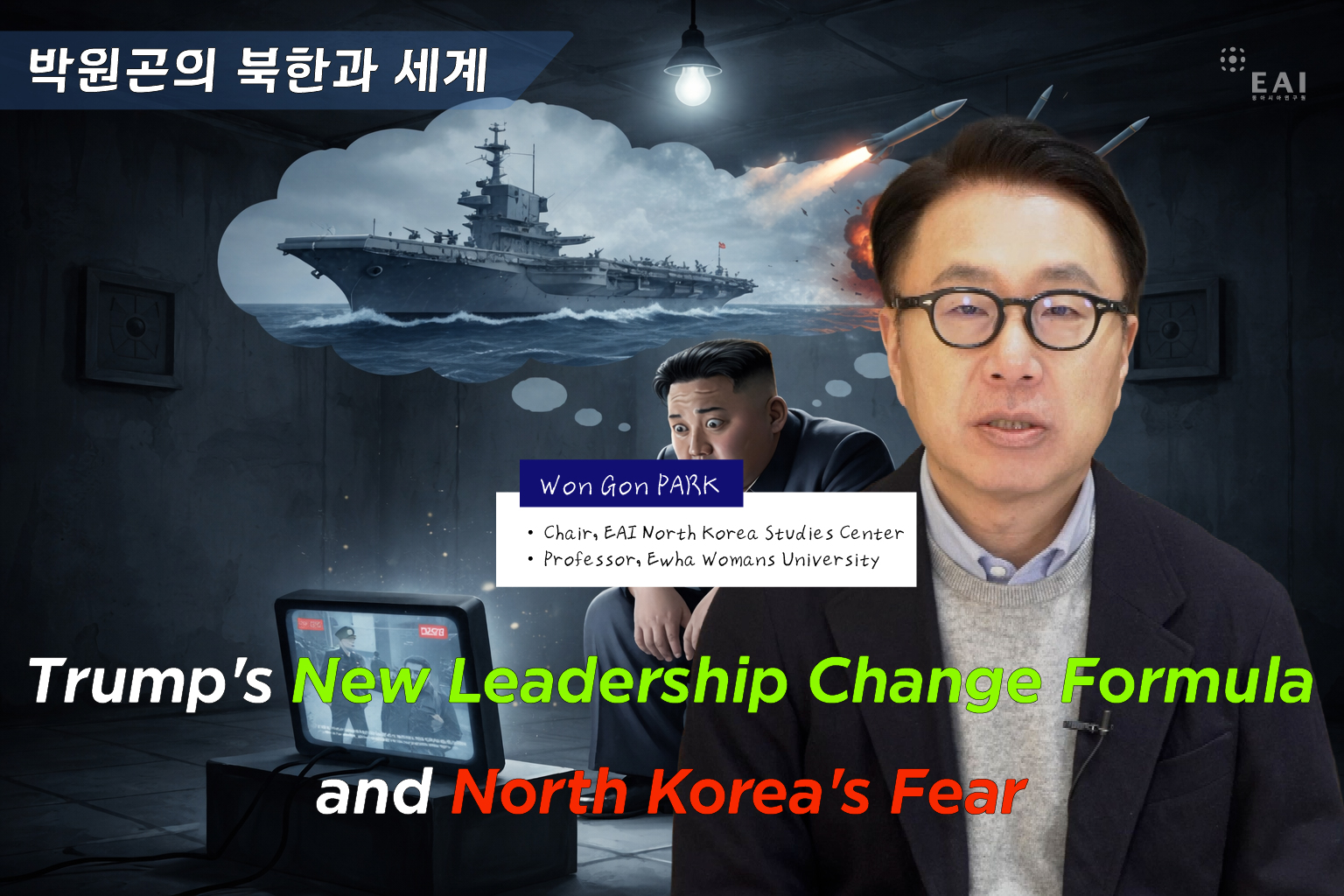
This is the issue. If this situation fails to garner support, it is judged that even if Trump does not make a military choice, methods such as show of force are possible. A scenario is unfolding where comparisons between Iran and North Korea are inevitable. In summary, I will address the impact on North Korea based on an assessment of the situation thus far. From North Korea's perspective, I believe their view of this Iran war will be extremely complicated and uncomfortable. In the broader framework, North Korea's Kim Jong Un regime will become more obsessed with nuclear possession. This is because Iran was ultimately subjected to U.S. military attacks due to its failure to properly develop nuclear weapons, resulting in a situation where even its supreme leader Khamenei was killed. Thus, North Korea witnessing Khamenei's death, going all-out to build justification for nuclear possession
North Korea will propagandize that its nuclear weapons are necessary for the sake of self-defense. Furthermore, there appears to be a possibility that the threshold for future negotiations between North Korea and the U.S. will be lowered. Didn't U.S. carrier strike groups, the Abraham Lincoln and Gerald Ford strike groups, deploy there? We suspected that there might be a military operation similar to the striking Iran's core nuclear facilities last June―but they are conducting a large-scale operation.
Furthermore, they even eliminated key command structures. The U.S. acted more strongly than we anticipated, thereby revealing Trump's unpredictability.
I believe Kim Jong Un's stance while observing this will bring 2017 to his mind. In 2017, President Trump said he would "Totally Destroy" North Korea. He very openly use the expression "Fire and Fury." Yet, coincidentally, the code name the U.S. mentioned for the operation in Iran was "Epic Fury." Seeing them use such similar expressions acts as no small burden from Kim Jong Un's perspective. Of course, North Korea is different from Iran, and because North Korea possesses nuclear capabilities, it is judged that the likelihood of the U.S. choosing a military option is extremely low. In 2017, the U.S. conducted a show of force by deploying three aircraft carrier strike groups and reviewed a localized 'bloody nose' strike strategy. However, this was ultimately not executed because North Korea possessed nuclear weapons, effectively holding South Korea and Japan hostage. In 2017, the nuclear capability that North Korea possessed was not sufficient to strike South Korea or Japan. Nevertheless, factors such as North Korea's nuclear weapons and the concerns that a single strike could escalate into an all-out war operated complexly, preventing a military choice. However, it is clear that it is even more difficult now. Despite this, from Kim Jong Un's perspective, having dealt with Trump, he knows that he is an individual with profound unpredictability, so there can be fear regarding this. Another point is that it is judged that North Korea is also aware that the U.S. is striking Iran and cannot continue to simply let North Korea off the hook. During the APEC Summit at the end of October last year, even though Trump continuously expressed his intention to meet him, Kim Jong Un repeatedly refused. However, if such a situation arises, continuous rejection becomes a considerable burden for North Korea. Strikes on Iran, Appeasement for North Korea?... Likelihood of negotiations decreases amidst U.S. criticism Taking everything into consideration, I think the possibility of North Korea coming to the negotiation table has actually become lower. Nonetheless, because the U.S. struck Iran even during negotiations, outright rejection of negotiations will inevitably become a massive burden for North Korea as well. One piece of counter-evidence regarding this is that as soon as the U.S. uncharacteristically took military action against Iran, North Korea immediately criticized the U.S. through a statement by a Ministry of Foreign Affairs spokesperson.
There are very few instances where North Korea rapidly issues their stance. Usually, they take time to organize and observe the direction in which things unfold, so coming out quickly is significant.
Another point is that upon observing the Ministry of Foreign Affairs spokesperson's statement, extremely restrained vocabulary was used. Trump is not mentioned at all for instance.
Although North Korea criticized the U.S., the statement did not use harsh language. I believe this reveals North Korea's burden regarding the might displayed by the U.S.
Today, I have discussed the impacts of the war in Iran while comparing Iran and North Korea at this juncture. Thank you. ■
■ Won Gon Park is the Chair of EAI Center for North Korea Studies and a Professor of North Korean Studies at Ewha Womans University.
■ Translated and edited by Sangjun LEE, EAI Research Associate; Inhwan OH, EAI Senior Research Fellow; Sowon KIM, EAI Intern.
For inquiries: 02 2277 1683 (ext. 211) | leesj@eai.or.kr